
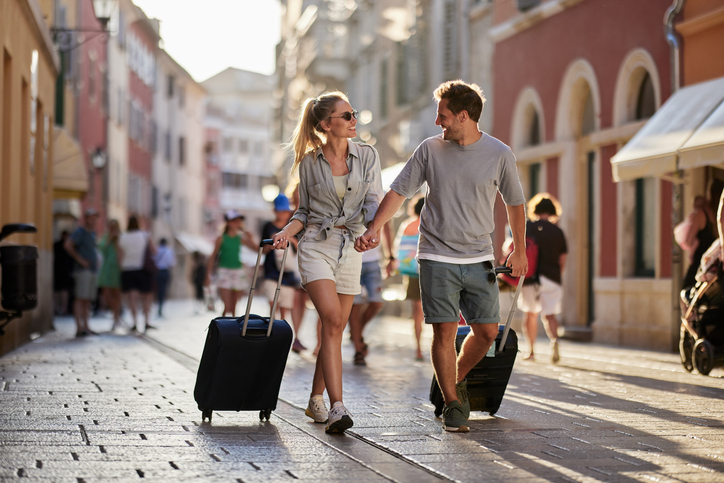
Sun or snow? Familiar or far-flung? Whatever shape your trip takes, some places simply lend themselves better to travelling as two.
This guide brings together some of the best holiday destinations for couples. It’s informed by our experience as a travel insurer, supporting people before they go, while they’re away, and when plans change.

1. Spain
Spain is a long-standing favourite with UK couples because it’s easy, varied and reliably good value. Flight times are short, costs are generally reasonable, and once you arrive there’s a lot close at hand, from city life and culture to beaches and resorts.
Barcelona
Barcelona combines busy city living with easy access to the sea. Its coastline runs alongside neighbourhoods like Barceloneta and Poblenou, making beach walks, swims and long lunches easy to fold into the day.
Culturally, Barcelona is Catalan rather than traditionally Spanish, which shows up in its language, food and identity. You’ll hear Catalan is spoken alongside Spanish, and see delicious local dishes like pa amb tomàquet and seafood rice on plenty of menus.
The city’s calendar is busy, with the main festival season running from April through to October. Sant Jordi on 23 April is a standout for couples. It combines World Book Day with Catalonia’s version of Valentine’s Day. The tradition is simple: books and red roses are exchanged. Traditionally, roses were given to women and books to men, symbolising love and knowledge. Across the city, streets fill with bookstalls and flower sellers, and local authors often sign copies outdoors.
Mallorca
Palma, Sóller and Alcúdia are popular bases, each offering good restaurants, stunning scenery and well-established amenities. English is widely spoken in these areas, which helps keep the day-to-day straightforward.
Beaches are, of course, a big part of Mallorca’s appeal. Long sandy bays such as Playa de Muro and Alcúdia Beach suit walks and easy swims side by side, while smaller calas like Cala Deià or Cala Llombards offer quieter places to spend an afternoon together. Many couples choose to see the coast by boat, from small self-drive hires to catamaran trips and private yacht charters with swim stops along the way.
Granada
Granada’s Moorish influence is easy to spot. Carved arches, tiled courtyards and shaded streets run through the city. Above it all sits the Alhambra, a former Moorish palace and fortress with open viewpoints towards the Sierra Nevada. Its patterned tiles, water channels and enclosed courtyards are instantly recognisable from travel photography and glossy magazines, but they’re far more striking in person.
Tea houses – teterías – are a distinctive part of daily life here, especially around the Albaicín. Most serve Arabic and North African teas in low-lit rooms with floor seating. It’s common to stop at one for drink and carry on conversation over a second or third glass.
Granada is also known for its hammams, inspired by the city’s Moorish bathhouse tradition. Warm pools and steam rooms offer time away from the heat and the street, where couples can sit side by side and slow things down together.

2. Portugal
Portugal offers a great solution to the city-or-coast debate. Towns, riverfronts and open coastline sit close together, making it easy to enjoy both without having to plan your trip around one or the other.
Lisbon
Colour is hard to miss in Lisbon. Azulejo tiles cover apartment buildings, stairwells and shopfronts across the city, turning even everyday streets into something special.
Much of the city is steep, which is why trams still play a practical role. Their small yellow carriages date back to the early 20th century and were built to handle tight corners and sharp gradients that buses can’t manage. Locals still use them for everyday journeys, while for visitors, the trams themselves are part of the appeal.
If you have an artistic streak, Lisbon makes that easy to explore. Tile-painting and printmaking workshops are widely available and tend to be informal and small-scale. You can book in to learn by doing, sharpen your skills or simply enjoy the process, even if the end result is more funny than frame-worthy.
Porto
Porto takes its name from the Portuguese word for harbour, a reminder of how closely the city has always been tied to the Douro River.
Ribeira is the city’s old riverside quarter, where the city opens straight onto the Douro. Narrow streets lead down to the water, with cafés, small restaurants and boat landings running along the river beneath the Dom Luís I Bridge. It’s where people come to eat, watch the boats or even step onto a river cruise.
Across the river, Vila Nova de Gaia is known for its port wine cellars. Visits range from brief tastings to guided tours explaining how port is made, stored and aged. Many end with time to choose a bottle to take home: a souvenir easily shared over dinner later or saved for a special occasion.
Algarve
The Algarve has been a favourite with British holidaymakers since the 1960s, when regular flights and purpose-built resorts first made the region easy to reach and enjoy. For many, it’s now a sunnier home from home, with Atlantic beaches and well-established amenities close at hand.
Golf is a major draw here. Courses around Vilamoura, Quinta do Lago and Vale do Lobo are well established and well maintained, set among pine forests and close to the coast. Fairways are generally built on sand-based soil that drains well, keeping courses playable throughout the year.
Mild winters make the Algarve a reliable choice beyond peak season, especially for couples who prefer to travel outside the busiest months.

3. France
France has always been closely associated with romance, which is why it remains a firm favourite with couples.
Paris
Paris is the city of love – and it’s loved right back. It’s a popular choice for milestone trips like Valentine’s Day, proposals and anniversaries, but isn’t necessarily tied to a single moment in the calendar.
Getting there from the UK is straightforward. Short flights serve Paris’s main airports, while the Eurostar runs directly into the city centre. Fares can be good value when booked in advance.
The Seine gives the city its structure, with Notre-Dame, the Louvre and the Musée d’Orsay sitting along the river or just off it. On places like the Pont des Arts, people pause by the remaining love-lock panels or watch boats pass below.
If you want to see the city from a different perspective, or arrange something a little special for your other half, a short boat trip is an easy option. Many run past the main sights along the river and offer different formats, from simple sightseeing trips to sailings with wine tastings or full three-course dinners served on board.
The French Riviera
The French Riviera is known for glamour, but day to day it’s more practical than you might expect.
If you like having everything within reach, Nice works well as a base. Much of the city is walkable. The Promenade des Anglais runs along the shoreline, while the old town behind it is a tight network of streets with food shops, cafés and small restaurants. It’s easy to pick up socca from a street stall, stop for coffee on Place Rossetti, or walk up to Colline du Château for views across the bay.
If you’re coming for the beach, it helps to know what to expect. Much of the Riviera coastline is pebbled rather than sandy, so water shoes are useful for swimming. Many couples choose to spend time on the water instead, either by joining short boat trips between bays or chartering a small boat to see the coast from offshore.
One of the Riviera’s best-kept secrets is its coastal train. It runs right along the shoreline, stopping at places like Antibes, Villefranche-sur-Mer, Monaco and Menton in under an hour. Journeys are short and scenic, with the sea visible for much of the route.
Provence
In Provence, daily life takes precedence over sightseeing. Farming, food and routine shape the region as much as any landmark, which gives it a slower, more settled feel.
If you’re drawn to small towns, places like Aix-en-Provence and the villages of the Luberon work well. Most are organised around a central square with cafés, bakeries and a weekly market. Market mornings are a fixture here.
The surrounding countryside is part of the experience. Lavender fields bloom in early summer, with farms welcoming visitors to walk the rows, photograph the fields or visit small distilleries producing oils, soaps and honey. Vineyards and olive groves fill the space between villages, many offering informal tastings, tours and picnics.

4. Italy
Italy brings together world-famous culture, well-loved food and cities shaped by centuries of history.
Rome
If you want a city where history is part of daily life rather than something need to you book tickets for, Rome is hard to beat. Ancient Roman, medieval and Renaissance buildings sit alongside each other across the centre, so the past feels woven into the present.
A walk for coffee might take you past the Pantheon, shopping streets run beside the Roman Forum, and traffic slows where the Colosseum meets the road. Many visitors stick to walking and taxis, but for a very Roman experience, guided Vespa tours/hire offer a unique way to take in the city sights.
Food-wise, Rome is known for a small set of simple dishes – carbonara, cacio e pepe and amatriciana – and for doing them consistently well. Lunch is often informal: pizza al taglio bought by weight, supplì from a bakery counter, or a short pasta menu. For couples who enjoy cooking as much as eating, hands-on pasta and tiramisu classes are easy to find.
Venice
Venice is built entirely around water. This means getting from place to place can take longer than the map suggests, but for many, that’s part of its appeal.
The Grand Canal is the city’s main route. Vaporetto water buses run its length and double as everyday transport and sightseeing, passing palazzi, churches and landmarks like the Rialto Bridge at water level. Gondolas, on the other hand, follow fixed routes through quieter side canals.
Beyond its waterways, Venice has a long tradition of performance and craft. La Fenice regularly stages full opera productions. Glassblowing studios on Murano and mask-making workshops in the city remain active working spaces, where visitors can watch or try their hand at something new together.
During the Carnival season, masked balls are a major part of the calendar. While they look exclusive, many are open to the public with tickets available in advance, offering a rare chance to experience the city’s historic social scene first-hand.
Lake Como
Lake Como has surged in popularity in recent years. Many of its historic villas now host weddings, proposals and private events, which has cemented its reputation as one of Italy’s most romantic settings.
Getting there is relatively straightforward via Milan, with trains running to towns like Varenna and Como. From there, ferries connect villages including Bellagio, Menaggio and Varenna, turning travel itself into part of the experience. Services are reliable but not always frequent, so check timetables well in advance.
For something more flexible, many couples book a private boat. It’s a practical way to see the villas up close, reach quieter stretches of shoreline, or move between towns without waiting on ferry schedules. Restaurants tend to cluster near the water and landing points, so it’s easy to pair a crossing with lunch by the lake before heading back.

5. United Kingdom
UK holidays are an increasingly popular choice among couples, with many rediscovering what’s on their doorstep.
The Lake District
The Lake District offers some of the UK’s most striking scenery. It’s well connected by car, and trains from London reach Oxenholme in around three hours, making it workable for long weekends as well as longer stays.
Walking is central here, but it’s not all hill climbs. Routes around Grasmere and Derwentwater are generally level and well maintained, following lake edges and village paths. Langdale and Borrowdale offer steeper ground for those who want it. Many walks finish near pubs or cafés, so it’s common to plan a route with lunch rather than milage in in mind.
Accommodation has shifted in recent years. Alongside traditional inns, there’s now a strong choice of spa hotels, modern lodges and private cabins. Lakeside pools, outdoor hot tubs and saunas are commonplace, with views across water or fells.
Edinburgh
Edinburgh may be a capital city, but it rarely feels sprawling or overwhelming. The historic Old Town and the Georgian New Town sit facing each other across Princes Street Gardens, close enough to move between easily but distinct in character. The former is steeped in history, with cobbled streets, closes and wynds running off the Royal Mile beneath the castle. The latter is more open and orderly, with Georgian streets lined with shops, galleries and cafés.
If you need space, it’s never far away. Arthur’s Seat rises straight out of the centre for short walks with wide views, while Calton Hill looks out over the city lights and landmarks. For an easy evening escape, South Queensferry is a popular choice for dinner with views of the Forth bridges.
In late summer, the Festival Fringe takes over theatres, pubs and pop-up venues across the city, giving couples the option to dip into comedy or theatre.
The Cotswolds
The Cotswolds delivers the storybook England many people picture. Pale stone villages sit close together among working farmland, and many former manor houses and coaching inns now run as well-regarded hotels, spas and dining rooms.
If you enjoy gentle walking rather than long hikes, much of the area links up easily. Paths follow rivers such as the Windrush and the Eye between villages like Bourton-on-the-Water, Lower Slaughter and Upper Slaughter, crossing fields and low bridges before ending somewhere you can stop for lunch or a drink.
For those who prefer exploring by car, the higher ground around Broadway offers quiet roads and open views. Elsewhere, steam railways still operate through parts of the countryside, and on calm mornings hot air balloons lift off from fields nearby.
Honorary mention: cruises
If you’ve looked through the options and still can’t quite land on one, a cruise might be the answer. You can stay in one cabin, unpack once, and keep the same level of comfort while destinations change around you.
For those who value having everything close at hand, life on board is a big part of the appeal. Modern ships are designed as destinations in their own right, with multiple restaurants, cafés and bars, alongside theatres, live music, spas, pools and quieter deck spaces. Meals are included, so there’s always somewhere to eat, whether that’s a formal dining room, a relaxed café or late-night service. Sea days give you time to use these facilities fully, without needing to plan around transport or opening times.
Mediterranean itineraries combine major cities with smaller coastal ports, while excursions cover everything from guided walks and food tastings to vineyard visits and boat trips. On rivers like the Rhine or Danube, ships dock directly in town centres, making it easy to step off and explore.
Don’t forget travel insurance
Has our list tempted you? Once you’ve settled on a destination and made your booking, there’s one sensible step to think about.
Travel insurance can help protect your plans if something unexpected happens before you go, not just while you’re away. It’s especially worth thinking about for trips with multiple stops, cruises, or holidays where excursions and pre-booked activities are part of the plan.
With Avanti, you’ll have:
-
-
- ✔Cancellation and baggage cover
- ✔24/7 emergency medical support
- ✔Cover for more than 1,300 pre-existing medical conditions* – and more
-
*Subject to screening. For full details, please see our policy documents.